

SSPN Test Site

Author: kwatt

  • SuperSport Schools and Omo are on the hunt for the Dirtiest Player at the Easter Festivals

    SuperSport Schools and Omo are on the hunt for the Dirtiest Player at the Easter Festivals

    Easter weekend means one thing in South African school sport: the rugby festivals are here, the grass is green, and somewhere out there, a parent is already pre-treating a rugby jersey.

    This year, SuperSport Schools and Omo are teaming up to celebrate the players who make washing sports kits a full-time job, and we could not be more excited about it.

    Introducing the Omo Dirtiest Player of the Match award, coming to every single game across the Easter Festival circuit.

    What does it take to win?

    Simple. Get stuck in. Give everything. Leave a piece of yourself and probably a grass stain or three on the field.

    Our commentary teams will be watching closely. Not for the prettiest feet or the slickest hands. They are looking for the player who has dived where others hesitated, tackled where others stepped aside and arrived home looking like they lost a fight with the pitch.

    A parent’s nightmare. A coach’s dream.

    Let’s be honest. There is a very specific type of parent reading this right now. You know who you are. You’re the one who checks the kitbag on the way to the car, sees what your child has done to a perfectly clean jersey and pair of crisp white shorts and quietly wonders whether it was actually necessary to slide through that puddle.

    It was necessary. It was absolutely necessary.

    The child who comes home with mud on their collar, turf in their boots and the unmistakable look of someone who left it all out there, that child is exactly who we are looking for. They are the heart of school sport. The ones who make the highlight reels, make the coaches proud and make the laundry basket overflow.

    At SuperSport Schools, we have always believed that the dirtiest players are often the most important ones on the field. The grinders. The grafters. The ones who do the unglamorous work that changes the result.

    Omo gets it too! Which is why this partnership makes complete sense. Because behind every brilliant, mud-covered, grass-stained performance, there is a parent doing a brilliant, unsung job of their own.

    Catch every moment across the Easter Festivals

    The Omo Dirtiest Player of the Match award will be handed out at St Johns, St Stithians, KES, Kearsney, and PBHS covering every match, every day, across the full festival circuit. Clips from every presentation will be posted across the SuperSport Schools social platforms, so you can follow the filthiest performances of the weekend in real time.

    To the players: get dirty. Get involved. Give absolutely everything.

    To the parents: stock up on Omo.

  • Commercialising school and youth sport is not the problem, underfunding it is

    School and youth sport has always carried pressure.
    Pressure to perform.

    Pressure to win.

    Pressure to balance academics, training and expectations.

    The idea that commercialisation somehow introduces pressure into an otherwise pressure-free environment is both naïve and unhelpful. Pressure already exists. The real question is whether we are equipping young athletes with the support systems they need to manage it safely, sustainably and successfully.

    That is where commercialisation, done properly, becomes not a risk, but a responsibility.

    The Funding Gap No One Likes Talking About

    Across South Africa, schools and universities are being asked to deliver more from their sports programmes than ever before:

    • Better and safer facilities
    • Qualified, specialised coaching
    • Proper medical, physiotherapy and conditioning support

    • Structured touring programmes
    • Access to balanced nutrition
    • In some cases, academic and educational support for student-athletes

    Yet many of these programmes are expected to operate on legacy budgets, goodwill and occasional sponsorship, often concentrated around a handful of headline sports.

    The result is predictable:

    • A few programmes thrive
    • Many operate under strain
    • Too many athletes fall through the cracks

    If we are serious about participation, inclusion and athlete welfare, then sustainable funding is not optional.

    Commercialisation Is About Investment, Not Exploitation

    The caricature of sponsorship as something that “uses” young athletes misses the point entirely.

    Responsible commercialisation:

    • Funds better coaching, not shortcuts
    • Pays for medical care, not pressure to play injured
    • Enables safer facilities, not riskier environments
    • Supports nutrition and recovery, not burnout
    • Creates access, not exclusion

    In fact, one could argue that the greater risk lies in underfunded sport, where:

    • Injuries go untreated
    • Coaches are overextended
    • Touring becomes inequitable
    • Nutrition is an afterthought
    • Mental and physical load is unmanaged

    Commercial support, when structured properly, allows institutions to reduce harmful pressures, not increase them.

    Young Athletes Are Already Under Pressure – Let’s Be Honest About That

    Let’s be clear:

    The pressures young people face today extend far beyond sport.

    Academic competition, social media, financial uncertainty, family expectations and future career anxiety all weigh heavily. Sport does not create this pressure, but it can either amplify it or help manage it, depending on how well resourced the system is.

    Well-funded sports environments:

    • Provide structure
    • Offer mentorship
    • Teach resilience and teamwork
    • Build identity and belonging
    • Create pathways rather than dead ends

    The presence of sponsors does not inherently add pressure. Poor governance and poor funding do.

    Why Measurement and Accountability Matter

    One of the most important shifts in recent years has been the move from informal sponsorship to measured, accountable partnerships.

    With proper data, schools and universities can:

    • Price sponsorship rights fairly
    • Protect athlete and institutional values
    • Set clear expectations with partners
    • Report transparently on value delivered
    • Reinvest income across multiple sports

    This is where organisations like Nielsen Sports South Africa play a critical role, helping institutions understand the real value of their audiences, events and content and ensuring that commercial decisions are evidence-based, not guesswork.

    Commercialisation without measurement is risky.

    Commercialisation with measurement is responsible.

    The Role of SuperSport Schools

    The rise of platforms like SuperSport Schools has fundamentally changed the landscape.

    Streaming has:

    • Made school sport visible at scale
    • Created measurable audiences
    • Opened new storytelling opportunities
    • Given the schools real media assets

    With visibility comes responsibility to use that exposure not just for pride, but for long-term sustainability. Commercialisation is the mechanism that converts exposure into investment.

    A Necessary Industry Conversation

    These issues will be unpacked in detail at the Nielsen Sports School and Youth Sport Commercialisation Conference, powered by SuperSport Schools, taking place 12th and 13th February 2026.

    The conference exists for one reason: to help schools and universities fund sport responsibly, professionally and sustainably across multiple codes.

    It is not about selling out.

    It is about stepping up.

    The Real Question We Should Be Asking

    The debate should not be:

    “Does sponsorship put pressure on young athletes?”

    The real question is:

    “Is it responsible to run ambitious sports programmes without properly funding the systems that support young people?”

    If we care about athlete welfare, inclusion and opportunity, then commercialisation done ethically and intelligently is part of the solution.

    School and youth sport are too important to be underfunded.

    And the future of South African sport depends on what we do about that.

  • Beyond the Rankings: Why school sport is bigger than a weekly ladder

    Beyond the Rankings: Why school sport is bigger than a weekly ladder

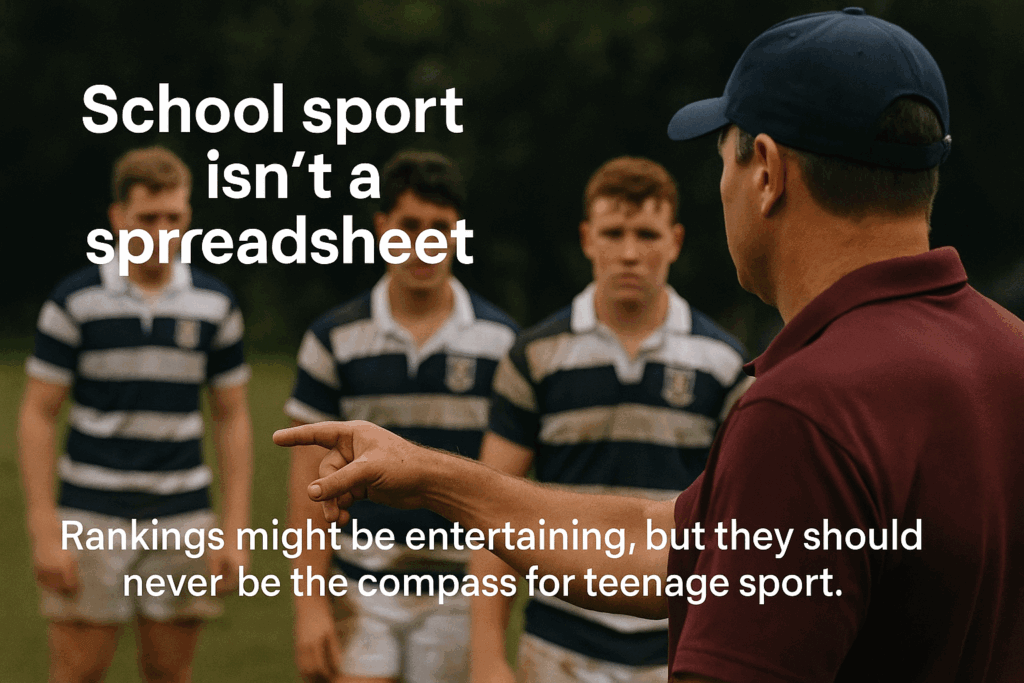
    School sport isn’t a spreadsheet. It’s early-morning buses, muddy socks, festival friendships and that one moment when a shy kid finds their voice. Rankings might be entertaining, but they should never be the compass for teenage sport.

    The recent article 6 Reasons Why School Sports Rankings Matter repeats the same arguments we’ve heard for years: rankings give teams “purpose,” raise standards, create national conversation, help with sponsorships, and spotlight excellence. It even claims rankings “track results, not reputations.”

    Here’s the problem: the maths behind these rankings isn’t neutral, and they’re definitely not reputation-free.

    The “one number” myth

    Most public ranking systems in SA take results, award bonus points for things like strength of opposition, margin, goals scored, venue—and in rugby, even Historic Strength—and then divide by matches to get an average that orders schools.

    Sounds tidy. It isn’t.

    • Small-sample bias: A school playing fewer games can hold onto a flattering average. A school that plays more fixtures introduces variance and gets punished. There’s no confidence interval, no margin of error—just a hard number that looks precise but isn’t.
    • Margin of victory incentives: Any system that rewards margin—even if capped—creates pressure to keep starters on longer, run up scores, and manage games for the table instead of player welfare. That’s not what school sport should be about.
    • Historic Strength: The claim that rankings “track results, not reputations” falls flat when reputation is literally baked into the formula. If your points are weighted by last year’s reputation, you’re not measuring results alone.
    • Schedule distortion: South African school calendars are uneven. Some schools barely cross provinces; inter-regional fixtures are sparse. That makes transitive comparisons (“we beat those who beat them”) unreliable. A polished number hides shaky maths.
    • Data quality: Festivals mean short turnarounds, different formats, astro versus grass, altitude versus sea level, home/away inconsistencies, and missing results. The formula treats all inputs as equal. They’re not.

    Rankings distort behaviour

    Beyond the maths, there’s a bigger issue: what happens when adults start chasing a ranking?

    • Coaches optimise for the table rather than development: fewer rotations, fewer opportunities for bubble players, less willingness to experiment.
    • It can push schools toward “fixture gaming”—picking opponents and timing to protect averages rather than stretch programmes.

    That’s not raising standards. It’s narrowing them.

    What actually raises standards

    At SuperSport Schools, we see something different working every week. High-intent viewership isn’t driven by who’s 7th or 9th on a list. It’s driven by derbies, festivals, rivalries, and stories about young talent that communities rally behind.

    That’s what builds sponsors’ value too: context, consistency, community. Not a number next to your school name.

    If people still want rankings…

    We’re not saying ignore data. But let’s do it better:

    • Move from a single table to a dashboard. Track a Form Index (last five games). Show Fixture Strength Quadrants (A/B/C/D level opponents). Publish Development Minutes(how many U16/U17 minutes are being played in 1st teams). Flag a Welfare Lens(minute loads, blowout frequency). Add Equity Adjusters (context like travel demands and facilities).
    • If a ladder must exist, put guardrails around it. Publish the full formula and weights, including how “Historic Strength” is set and decays. Show tiers with uncertainty, not a false 1–100 precision. Enforce minimum game thresholds and normalise festival conditions. Cap margins with diminishing returns, so there’s no incentive to chase 50-point wins. Recalibrate home/away adjustments annually.

    That would at least make it transparent, credible, and less distorting.

    Our choice

    For us, the bigger scoreboard isn’t a number on a website. It’s how many kids are playing, how many parents are engaged, how many communities are connecting through sport. It’s how often school sport becomes a platform for growth, belonging, and opportunity.

    That’s what we’ll have to continue to invest in within school sports.

    Because school sport is about far more than a rank—it’s about moments, memories, and pathways that last a lifetime.

    These views are the views of the author and do not necessarily reflect the opinion of SuperSport Schools.