Going at an impressive rate of nearly a run-a-ball, Kotze punished the Iinyathi bowlers, smashing nine fours and one six as he made his way to a very entertaining 93 runs before he became Yonelisa Mkhohliswa‘s first and only victim, falling just seven runs short of a deserved century.
Sihle Dume took a leaf from Kotze’s book. The opening batsman occupied the crease with intent to bring up a well-deserved half-century, his first of the week, to help North West to a competitive 254/7 in the allotted 50 overs.
Unfortunately for Iinyathi, only Connor Folwes was able to make a noteworthy contribution. Fowles, just like Kotze and Dume, batted suberbly, hitting seven fours and two sixes for his 62 runs, but it would not be enough as he watched on as his side suffered a comprehensive 95-run loss.
The Limpopo Impalas‘ Benjie Mathebula also let his bat do the talking, leading the side from the north to their first victory at this year’s week, over Northern Cape. Having to work hard, with the Northern Cape bowlers fighting to defend a below-par score of 147, Mathebula faced 93 deliveries for his match-winning 75 runs, which included 10 glorious fours.
His innings kept the Impala ship afloat after Carl Thole‘s good effort of 3/28, steering it home with just three wickets to spare.
Luan Sibrits also came agonisingly close to scoring the first century of the week, smashing Kei to all corners of the ground as Mpumalanga got back to winning ways, beating their Eastern Cape counterparts by a whopping 170 runs.
Facing an impressive 120 deliveries, Sibrits accumulated 97 runs. Making his innings even more impressive is the fact that he only hit five boundaries, as he delivered a masterclass of running between the wickets. Herman Potgieter seemingly enjoyed batting with Sibrits, as he, too, notched a well-played 56, while Wian van Heerden followed suit with an unbeaten 50 of his own.
Daniel Hattingh and FG Botha continued their purple patch with the willow, leading Free State to victory over the high-flying Easterns. In reply, the talented Easterns all-rounder Stephan Vermaak showcased his batting prowess with a proper innings of 53, yet, his side had to settle for a 47-run defeat.
Summarised scorecards:
North West 254/7 (Lukas Kotze 93, Sihle Dume 53, Andre Dreyer 25, Christivan Coetzer 20; Ambese Linda 2/57, Matt Hendry 2/27); Eastern Cape Iinyathi 159 (Connor Fowles 62, Ambese Linda 22; Omphile Rangwaga 2/16, Olefa Padi 2/27, Thloni Thabatha 2/32). North West won by 95 runs.
Northern Cape 147 (Kieran Adams 31, Extras 31; Stephan Swanepoel 2/5, Ripfumelo Mabunda 2/27, Limni Lu Heswick 2/31); Limpopo Impalas 151/7 (Benjie Mathebula 75, Jaco van der Westhuyzen 28*; Carl Thole 3/28, Faizaan Kajee 2/26). Limpopo Impalas won by three wickets.
Mpumalanga 276/7 (Luan Sibrits 97, Herman Potgieter 56, Wian van Heerden 50*, Extras 29; Lukhanyo Nkomonye 3/43, Sanele Mphathelwa 2/54); Kei 106 (Extras 36, Siphumeze Nonwana 34, Lukhanyo Nkomonye 22; Adil Larya 3/37, Eduan Strydom 2/5, Ashley Khumalo 2/11, Nayhasa Gwaraba 2/29). Mpumalanga won by 170 runs.
Free State 192 (Daniel Hattingh 55, FG Botha 45, Eddie Mabena 30; Sohil Jagnath 2/5, Rieshaeel Hashim 2/18, Oluhle Sibali 2/48); Easterns 145 (Stephan Vermaak 53, Aiden Shaw 34, Extras 25; Jano Venter 3/26, FG Botha 2/26, Daniel Hattigh 2/28). Free State won by 47 runs.
Playing in a Jukskei derby is always special but it’s even more special playing a match-winning innings to get your side across the line, which is exactly what Bafana Muthunzi did against the Titans on the third day.
Coming off the back of a solid bowling performance led by Zaakir Hanslo, with 3/40, and support from Luke Clark (2/25) and Kyle Butler (2/43), Muthunzi led the way with the bat to top score with a well-played 52 not out. Nkosana Sibiya provided a supporting knock of 46, while Ombesa Matsha chipped in with a valuable 31 to secure a convincing five-wicket victory.
At one stage, the Titans were on top, when opening batsman, Timothy Gordon, got going, before he was eventually sent back to the pavilion for an impressive 78. Vihan Pretorius continued to show his class, but still couldn’t kick on for a first half-century of the week, losing his wicket for 42 as the Titans could only reach 194 when the last wicket fell.
Francois Prins ruled with the bat for Boland against an unbeaten and confident Eastern Province side. His innings of 86 set the tone for the side from down south. The talented Wian Munnik followed suit with an equally impressive innings of 60, as the pair prepared the way for their bowling attack.
The bowlers obliged with a dominant performance. Aiden Batt wasted no time tearing down the EP top order with a return of four wickets for only 26 runs. Munnik, full of confidence after his innings with the willow, contributed once more, snapping up two wickets as EP slumped to a 103-run defeat.
Shiraz Perumal (3/4), Litha Gonya (3/14) and Kressan Pillai (3/20) thumped the Garden Route Badgers, sharing nine wickets between them to seal a massive 183-run victory for the Dolphins.
Pillay also found himself amongst the runs, sharing the spoils of good effort with the likes of David de Bruyn, who top scored with 40 runs, and Kyle McGough‘s 37, as they posted a useful score of 260. It proved a bridge too far for the Badgers, who could only manage 77 all out.
A bowling masterclass by Benjamin Blackburn helped Western Province dismantle the Tuskers‘ batting, making life a lot easier for his batsmen. Bowling his full quota of 10 overs, Blackburn conceded a mere 12 runs for his five wickets, restricting the side from the Midlands of KwaZulu-Natal to a meagre 68 – a total his batters would chase down with comfort, reaching the required target in the 25th over.
Summarised scorecards:
Titans 194 (Timothy Gordon 78, Vihan Pretorius 42, Righardt Joubert 31; Zaakir Hanslo 3/40, Luke Clark 2/25, Kyle Butler 2/43); Central Gauteng Lions 195/5 (Bafana Muthunzi 52*, Nkosana Sibiya 46, Ombesa Matsha 31; Rehaan Patel 2/39). Central Gauteng Lions won by five wickets.
Boland 225/9 (Francois Prins 86, Wian Munnik 60; James Badenhorst 3/24, Rhys Wiblin 3/48, Sulaymaan Gangat 2/36); Eastern Province 122 (Frederick Jansen 27, Muhammad Kazi 23; Aden Batt 4/26, Wian Munnik 2/17). Boland won by 103 runs.
Dolphins 260 (David de Bruyn 40, Kyle Mcgough 37, Kressan Pillai 34, Shiraz Perumal 32, Tristan Delvin 24; Matthew Coleman 3/55, Qhamani Veiwer 2/34, Hanni Swart 2/47); Garden Route Badgers 77 (Daylenn Williams 21*, Jordan Ross 20; Shiraz Perumal 3/4, Litha Gonya 3/14, Kressan Pillai 3/20). Dolphins won by 183 runs.
Tuskers 68 (Thandowelthu Zama 25; Benjamin Blackburn 5/12, Unathi Magoloza 2/9, Joseph-John Rothman 2/9); Western Province 69/3 (Tyler Heyns 27; Kaiyuran Naidoo 3/24). Western Province won by seven wickets.
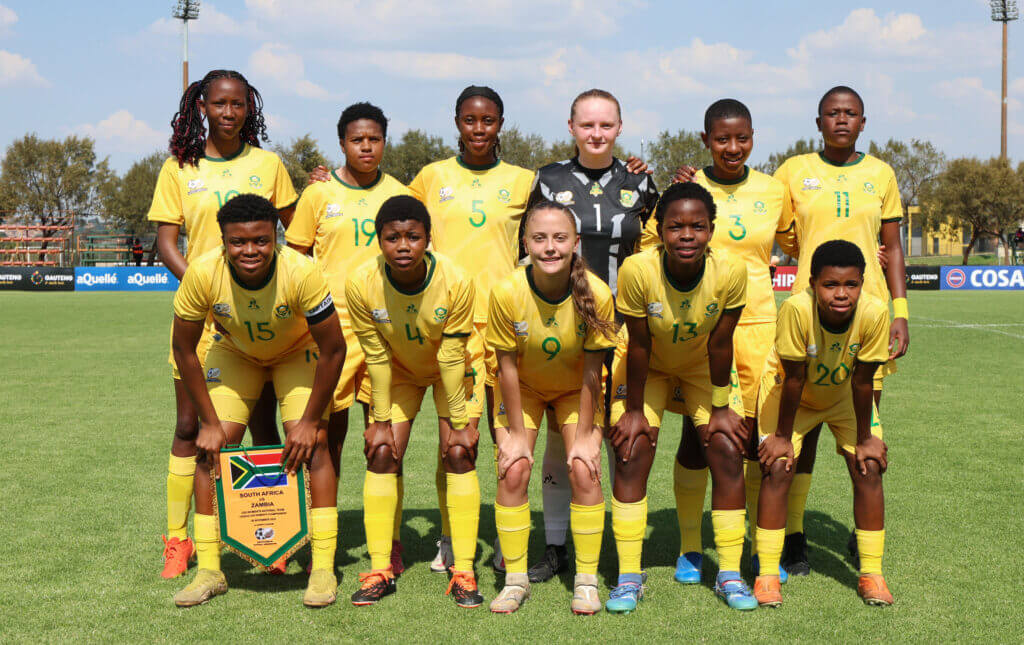
South Africa’s team photo, taken during the 2024 Cosafa Women’s u20 Championship match between South Africa and Zambia at the UJ Stadium, Soweto on 20 November 2024. Photo: Muzi Ntombela/BackpagePix.
The draw for the u17 and u20 Confederation of African Football (Caf) | Fifa Women’s World Cup qualifiers was held at Caf headquarters in Cairo, Egypt, on Thursday.
The u17 South African team, known as “Bantwana”, will face Gabon in the initial round of the qualifiers.
Bantwana’s home game takes place over the weekend of 10-12 January 2025, with the away match following a week later, on the weekend of 17-19 January.
The South African u17 side will be desperate to get by the Gabonese after missing out on qualification for the 2024 Fifa Women’s World Cup, which was held in the Dominican Republic in November.
The African representatives were Kenya, who qualified for the event for the first time, Nigeria, who made a seventh appearance at the event, and Zambia, who qualified for the second time. Nigeria made it to the quarterfinals, where the five-time African champions fell to the United States, who went on to finish third.
North Korea won the tournament for a third time, beating Spain 4-3 on penalties in the final after the sides had finished regulation time level at 1-1.
The Fifa u17 Women’s World Cup will take place from 17 October to 8 November 2025, with Morocco hosting the ninth edition of the event. It will be the first time that it is played in Africa.
Seven teams out of 24, including the host nation, Morocco, have already qualified. The others are New Zealand, Samoa, Japan, North Korea, South Korea, and China.
The qualifying competitions that are still to be concluded include the CAF u17 Women’s World Cup Qualification 2025, Concacaf Women’s Qualifiers 2025, Conmebol Sub u17 Femenino 2025, and the Uefa Women’s u17 Championship 2024/25.
South Africa’s u20 women’s team, “Basetsana”, takes on the country’s neighbours, Eswatini, in the first leg of qualifying for the 2026 FIFA u20 Women’s World Cup. Their first match will be played on the weekend of 9-11 May 2025, with the second following on the weekend of 16-18 May.
South Africa missed out on qualification for the 2024 Fifa u20 Women’s World Cup in Colombia. The 24 finalists included four African sides: Cameroon, Ghana, Morocco, and Nigeria.
The best of the African countries were Cameroon and Nigeria, who were eliminated in the round of 16. Cameroon went down to Brazil 1-3 after extra time, with the Brazilians bowing out 0-1 to North Korea in the quarterfinals. Nigeria lost 1-2 to the runners-up, Japan. Like their u-17 team, North Korea won the title, edging out Japan 1-0 in the final.
The next Fifa u20 Women’s World Cup takes place in Poland in August 2026.
With the 2024 Gauteng Development League (GDL) now in the history books, SuperSport Schools Plus explores the journeys of the teams that triumphed this season under the “Champions Series” banner.
This week, Ongama Gcwabe narrates the story of the u19 champions, Highlands Park, with the help of head coach Sifiso Mnguni.
Highlands Park constructed a unique journey this season. The fact that the team won back-to-back league titles might lead some to mistakenly think that “The ‘Lions of the North” were dominant throughout their two title-winning campaigns.
They were dominant in 2023, but coach Sifiso Mnguni and his charges had a much tougher path to the title of champions this year. They were nearly flawless last year, but it took a gritty, stubborn effort to repeat as the league winners.
Mnguni was struck with many unexpected challenges at the start of the year. One of the biggest was the loss of key players, which forced Mnguni to put together a plan B.
Early in the season, Highlands Park dropped some points while their rivals, Mamelodi Sundowns, were dominating the u19 division. Mnguni, though, finally found and settled on the right personnel, courtesy of a very efficient recruitment structure at Balfour Park.
“With the start, we lost a few points. We did not have the full team. We lost a few boys. One went to Cape Town, and the others were going to university. We did not start very well, so we needed to regroup,” Mnguni opened up in an exclusive interview with SuperSport Schools Plus.
“We were not so happy with the team and we needed to recruit new faces. So, the start was just difficult because we had to put the team together and put a structure together.”
With the new team lineup established, the next task for Mnguni was to build camaraderie and establish a strong culture. Most often, those elements are built when a team goes through tough times, and when Mnguni took his team to Cape Town for the Bayhill Premier Cup, they were met with stiff opposition.
Instead of fracturing, the Highlands Park boys gravitated towards one another, a feat that Mnguni described as the highlight of the season and the key element in their successful defence of the GDL title.
“When I look back, we went to the Bayhill tournament in Cape Town, and I thought this is a new team and the tournament might be difficult, but the boys showed us their true colours,” Mnguni said.
“The trip to Cape Town, I thought it brought us closer, it strengthened the bonds. We reached the semis of the Bayhill, which is a very difficult tournament.
“In that space, we had to learn a little bit more about each other and that prepared us for the things that we would have [to deal with] throughout the season.
“That trip brought us all together and I would say it was the moment that made us champions.”
With the team being fairly new, Mnguni had to change his tactics and tailor-make them for the 2024 class.
In the title-winning 2023 season, Highlands Park played with three defenders at the back. In 2024, Mnguni switched to four defenders in an attempt to strengthen what was a rather inexperienced defensive line.
Moreover, because of his side’s inexperience, Mnguni and his backroom staff had to find ways to accelerate the development of his players, to help them understand what was required of them at the u19 GDL level.
“I don’t think we did anything much different except that I feel we needed to work harder on the boys. Basically, we worked harder on the video analysis sessions and the corrections, and we were a little more aggressive in our approach in the video analysis room,” he revealed.
“I don’t think we were the most talented side but we were the hardest-working side in the GDL. You could see the [low] number of goals we conceded, the numbers reflect the amount of work we did in the background.
“Perhaps the only difference was that last year we played with three at the back, but this year we felt we were too vulnerable, so we opted to go with four at the back but still maintained the three-two build-up.”
Omphemetse Sekgoto, of South Africa, is tackled by Chrismc Rabaye, of Mauritius, during the TOTALEnergies u17 Africa Cup of Nations Cosafa Qualifiers, Cosafa u17 Boys Championship match between South Africa and Mauritius at UJ AW Muller Stadium in Johannesburg on 9 December 2024. Photo: Samuel Shivambu/BackpagePix.
South Africa was eliminated from the TotalEnergies CAF u17 Africa Cup of Nations | Cosafa qualifier after losing 1-2 to Zambia in the semi-finals at the University of Johannesburg (UJ) AW Muller in Johannesburg on Wednesday.
Many people called the clash the final before the final, with the winner expected to go on to claim the title.
The Zambian side and South Africa arrived with well-prepared, strong squads, ready to battle it out for a place in next year’s u17 Africa Cup of Nations. Unfortunately, for the host nation, their hopes were dashed.
They started well, though, snatching the lead in only the second minute when Simphiwe Mlondo scored following an excellent pass from Emile Witbooi, who posed a significant threat to Zambia with his impressive skills, passes, and well-timed runs. However, in the second half, Zambia effectively neutralised his impact.
The Zambians drew level when Abel Nyirongo converted a penalty.
The intensity of the match was not restricted to the playing field. In the stands, the rivalry was also palpable among the fans, who engaged in chants and banter as they got behind their teams. On the field, the game was characterised by physical contests, which presented the smaller South African players with a stiff challenge.
Witbooi, especially, was on the end of special attention, which led to him having a knee strapped within the first 20 minutes of the game.
The Video Assistant Referee (VAR) system, introduced by the Council of Southern Africa Football Association (Cosafa), was utilised during the semi-finals of both the boys’ and girls’ u17 Cosafa tournaments. It played a huge role in the match between South Africa and Zambia, which led to 20 minutes of stoppages in the first half due to several interruptions.
The game was filled with drama and confusion. In the 24th minute, Zambian midfielder Vincent Mutondo was shown a red card for a reckless tackle on Mlondo following an extensive VAR review. The Zambians were down to 10 men, but South Africa’s goalkeeper Lwandiso Radebe was also shown a red card shortly thereafter for handling the ball outside the penalty area. That decision was confirmed by the match official, Brighton Chimene, resulting in Radebe also exiting the contest early.
In the second half of the match, Zambia slotted a second goal in the 68th minute when the ball slipped through the legs of goalkeeper Lehlohonolo Mosia at the near post. Substitute Robert Banda quickly capitalised, scoring from within the goal area.
During that period of the match, South Africa struggled with ball retention, frequently conceding possession and allowing their opponents to take control. Selywn Stevens and Witbooi were unable to effectively engage the wing players.
In the closing moments of the clash, play was temporarily halted due to lightning and thunder. When it resumed, with only a few minutes remaining, South Africa was unable to alter the outcome, resulting in their failure to qualify for next year’s u17 Africa Cup of Nations.
The 1-2 defeat was painful for the many South African fans in attendance. They recognised that a squad brimming with talent had missed out on a good opportunity.
Zambia will face Angola, who progressed from the other semi-final after defeating Zimbabwe 2-0, for the title and a place in the Africa Cup of Nations.
The finals of the u17 Cosafa tournaments will be played on Friday, 13 December, at the UJ Soweto Campus Stadium and will be streamed on FIFA+.
While Angola and Zambia will meet in the boys’ title decider, the u17 Girls’ Cosafa Championship will be played between Zambia and Lesotho, with the Zambians eager to clinch the double and be crowned the u17 champions of Cosafa in both events.
Something was missing at the 2024 edition of the Schools Water Polo South Africa Inter-Provincial Tournament in East London. No one heard Ian Melliar’s infectious laugh or his baritone voice discussing the game with officials, parents, and players. He was nowhere to be seen at the opening ceremony or by the poolside during the aquatic showpiece.
It was the first time since 1978 that the water polo legend followed the action through online streaming, and articles on the matches.
However, his presence was undeniable. Melliar has been in the sport for so long that he has had a direct or indirect impact on everyone attending. His name is synonymous with water polo in South Africa.
Wendy Way’s name is spoken with reverence in the Camps Bay area. It is almost impossible to speak of swimming in the area without mentioning her name. She was the Camps Bay Swimming Club. She established it and used it as a vehicle to teach young people the craft. Melliar was one of her earliest pupils.
His happy place was in the Camps Bay municipal pool and the ocean. He learned to swim when he was five and spent whatever free time he had in those two bodies of water.
“I just seemed to grow a passion for water. I loved all sports, but swimming was my primary love,” he shared.
Way officially opened her swimming club in 1966 and Melliar was one of the first youngsters to sign up. However, he wasn’t just one of Way’s first students, he was also one of her first three Currie Cup swimmers. Mellier competed in the 100- and 200-metres butterfly at the 1977 Currie Cup Swimming Championships. The other disciplines at the event were springboard diving, synchronised swimming, and water polo.
“I enjoyed the swimming, but then when I was watching the water polo, I admired the team dynamic it had. I used to spend long hours alone in the pool working on my discipline. It was hours of swimming up and down in a lane at training and doing the same at competitions,” Melliar recalled.
He was a big fan of team sports. He thrived in them. He played rugby during his high school years at Wynberg Boys’ High and was a member of the Villagers team after school. He also played cricket.
In 1977, he was 17 and the first thing he did after he got home was look for a water polo club to join. He ended up with the Vikings Waterpolo Club in Sea Point. He was a natural at the sport. Melliar immediately caught the eye of the Western Province selectors, who picked him for the provincial side that took part in the 1978 IPTs.
That was the beginning of a playing career that lasted for over a decade.
***************
Melliar with other officials at the 2000 Sydney Olympics.
“I had a single goal as a young man, and that was to get to the Olympics. That was my end outcome,” Melliar revealed.
However, in the 1980s, that goal did not seem realistic. South Africa was under sanctions and unwelcome on the international stage because of apartheid. Melliar, who became aware of the system only when he was older and witnessed it in action, had robust discussions with his father on the downsides of a country espousing such a model of governance. He could not understand why it was in place.
“I just couldn’t believe how people were completely ostracised, telling them sorry you can’t swim here, that beaches were for whites only and you got to go there. It really got me going with my dad. I had many discussions about it with him. You can’t treat people like that. It’s impossible,” Melliar said.
However, with or without it, Melliar had resolved that his Mount Everest was the Olympics.
“I realised early on that the only way I would get to the Olympics was as a coach or referee. I started my refereeing at school level in the Western Cape at junior school matches and then grew into the senior matches when I stopped playing club water polo,” he recalled.
He coached the Western Province Schools A and B teams from 1986 to 1992.
The first steps towards the realisation of his Olympics’ dream arrived in 1992 when the world was opening its doors to South African sportspeople and officials again. Melliar was part of a delegation of swimmers, water polo players, divers, coaches, and referees that was invited to Hungary for a tournament.
“There was a meeting at the end of the whole thing. An international panel had been watching us at some of the matches we officiated. They told us that there were four referees from South Africa that were accepted onto the international panel. They said that they thought they would pick only one referee, which would have been me, but we ended up with three,” Melliar said.
However, he had to wait another 12 months before he officiated in his maiden international water polo match. He was nominated to referee at the Junior World Championships in Cairo, Egypt. The veteran remembers the game as if was played yesterday.
“The match was between China and Brazil, their u20 teams. If my memory serves me right, China beat Brazil by two goals,” Melliar shared.
That was the beginning of a long and illustrious career of officiating at international events, in various age groups, and at World Cups as a neutral referee or with the South African team. However, the greatest moment of his career came seven years after his first international match. Melliar refereed at the 2000 Sydney Olympics.
“It was an amazing experience. I was one of the two referees who reffed in the first ever Women’s Olympic Games match between Australia and Kazakhstan in Sydney,” Melliar fondly recollected.
Almost 20 years after he had set the goal for himself, Melliar achieved it. He was 40. What made the experience even more surreal was that he was at the forefront of change in water polo, a change led by the Australian women’s team’s single-minded determination to be a part of the sporting showpiece.
For years, the Australian women’s water polo team had a delegation of players act as welcoming parties for Olympic Games and FINA officials visiting the country. They begged and accosted the visiting administrators to consider adding water polo to women’s disciplines at the Olympics. Melliar feels a deep sense of pride that he was part of the history-making event.
*****************
Ian Melliar at the 1978 IPTs, the tournament that changed his life forever.“
“I have lived a blessed life. I got to experience something I had dreamed of for many years, and I also had the privilege of being part of a sport I love so much,” Melliar said.
Melliar held various positions and performed various functions within the Western Province water polo fraternity. He was one of the people at the forefront of developing the sport in Eden Districts and the South Western Districts aquatics union.
He coached in schools, and ever eager to contribute to the code’s growth and well-being, Melliar took a number of referees under his wing, some of whom officiated at the 2024 IPTs.
However, despite all of these successes, there remains a single regret. In his single-minded pursuit to achieve his Olympic dream, he did not give his family as much time as they deserved. It was a sacrifice he unknowingly made.
“Maybe I should have worried about my goal and my sports dream before I had a family. That’s the only regret I have,” Melliar candidly said.
Sadness came over him as he recounted what he considered the biggest mistake he made in his life. Melliar accepted that he couldn’t go back in time to undo the decisions he made, but he could do better in the present.
On 9 December 2024, he celebrated his 64th birthday. He fielded beautifully worded messages from friends, colleagues, and many people he had crossed paths with.
“Water polo has given me lifelong friendships, countless memories, and a profound appreciation for the values of sportsmanship, discipline, and resilience. I am deeply thankful to my family, colleagues, players, coaches, and the community who supported me throughout this incredible journey,” he said.
However, this time around, Ian Melliar shared his special day with his family and a handful of friends. It was the first time in 46 years that he had celebrated the day at home. He missed the action and being around the competing provincial sides. However, there was also a feeling of satisfaction. For 48 years he had selflessly contributed to the growth of water polo in South Africa in numerous ways, and now he has passed on the baton to the next generation of leaders.
While he is scaling back on his workload, he has not withdrawn his support and contributions to the code completely. He is still active, but on a smaller scale, and he is enjoying his new chapter.
“Reflecting on these decades, I am filled with immense pride, gratitude, and a deep sense of fulfillment. Officiating at World Championships, Junior World Championships, and over 45 IPT schools tournaments and countless senior and junior provincial events has allowed me to witness the growth of our sport and the rise of future champions,” Melliar smiled.
Kirk Wilson’s selection for the South African Schools squad was also a reflection of Durban High School’s ascending water polo programme. Photo: Brad Morgan.
The u19 finalists, Central Gauteng A and KwaZulu-Natal A, both had five players selected for the South African Schools squad, which was announced at the Schools Water Polo South Africa Inter-Provincial Tournament in East London on Wednesday.
Four players from Western Province were included, while the hosts, Buffalo City, celebrated the selection of Liam Hansen and Thomas Caswell. They were part of an all-Selborne College team that impressed with their hustle and never-say-die spirit, and which carried them to fourth place in the tournament.
The champions, Central Gauteng, had two players from St John’s College, Ross Rovelli and Greg Pryce, selected, while Pryce was named the Best Defender for a second year in succession. There was further success for St John’s when Jon-Marc De Carvalho was named the coach of the national side.
King Edward VII (KES) had goalkeeper Judah Dos Santos and defender Karabo Mamaregane selected for the side, while Marc Smith, of St Stithians, who was named the Player of the Tournament, also cracked the nod.
The KwaZulu-Natal contingent included players from five different schools. The Goalkeeper of the Tournament, Ross Strauss, of Clifton College, was picked, as was the Best Attacker, Tristan Uys, of Hilton College.
They were joined by Kirk Wilson, of Durban High School (DHS), Northwood‘s Matthew Lortan, and James Pohl, from the Saints Invitational Water Polo champions, Kearsney College.
The Western Province quartet included two players from Bishops Diocesan College, Thomas Truter and Ross Stewart, while Nicholas Fall, last year’s Best Attacker, who enjoyed another outstanding tournament, was selected for a second year in a row. They were joined by Arkin Marais, of Paul Roos Gimnasium.
The team will be managed by Glenwood‘s Rob Ambler.
SOUTH AFRICAN SCHOOLS SQUAD
Arkin Marais (Paul Roos Gimnasium, Western Province), Greg Pryce (St John’s College, Central Gauteng), James Pohl (Kearsney College, KwaZulu-Natal), Judah Dos Santos (King Edward VII, Central Gauteng), Karabo Mamaregane (King Edward VII, Central Gauteng), Kirk Wilson (Durban High School, KwaZulu-Natal), Liam Hansen (Selborne College, Buffalo City), Marc Smith (St Stithians, Central Gauteng), Matthew Lorton (Northwood, KwaZulu-Natal), Nicholas Fall (SACS, Western Province A), Ross Rovelli (St John’s College, Central Gauteng), Ross Stewart (Bishops, Western Province), Ross Strauss (Clifton College, KwaZulu-Natal), Thomas Caswell (Selborne College, Buffalo City), Thomas Truter (Bishops, Western Province), Tristan Uys (Hilton College, KwaZulu-Natal).
Manager: Rob Ambler (KwaZulu-Natal)
Coach: Jon-Marc De Carvalho (Central Gauteng)
Nelson Mandela Bay’s Teagan Harty impressed for her team during the week and was rewarded with an SA Schools selection. Photo: TeamPhoto SA
Five players each from Central Gauteng and Western Province were rewarded for their impressive performances at the Schools Water Polo South Africa Inter-Provincial Tournament with selection for the South African Schools squad.
The 15-player line-up was announced after Gauteng defeated Province 7-3 in the final of the tournament at the Joan Harrison East Swimming Pool in East London on Wednesday.
The IPT title was Gauteng’s second in succession after they won last year’s final against the same opponents in Gqeberha.
Gauteng was not at their best during the pool stage of the competition, but they played some enterprising and effective water polo and outsmarted Province tactically on the final day.
As a result, a handful of their players were included in the SA Schools squad. Two of them, Amy Smith and Mia Loizides, were included in last year’s squad.
Meanwhile, both Central Gauteng goalkeepers, Lucy Davis and Ogechi McMurray, cracked the nod along with Ruby Carlson.
Province also has five representatives in the team, and two of them featured in 2023. Hannah Banks and Emma Catto were selected again, while Roxanne Uys, Iviwe Tracy Oduore, and Alexa De Villiers joined them in the national side.
Coach Grant McKenzie’s Nelson Mandela Bay side finished in an impressive third place and three of their standout players played their way into the national lineup.
Matipa Karimazondo got her name on the list for another year, while Amie Jenner and their goalscoring machine, Teagan Harty, were also rewarded.
Both KwaZulu-Natal and Buffalo City A endured underwhelming outings, and finished in fifth and sixth respectively, but each had a player named in the team.
Inge Southey was the KZN rep, while Tori Voke, from Buffalo City, was also included.
Western Province’s Hannah Banks took the best forward accolade, while Mia Loizides was crowned the Defender of the Tournament.
Davis was in top form for Gauteng in the cage, which earned her the Goalkeeper of the Tournament award.
The Player of the Tournament went to Alexa De Villiers, who excelled for Province and who was, at times, the difference between winning and losing.
SOUTH AFRICAN SCHOOLS SQUAD
Alexa De Villiers (Herschel Girls School, Western Province), Hannah Banks (Reddam House Constantia, Western Province), Emma Catto (Reddam House Constantia, Western Province), Roxanne Uys (Reddam House Constantia, Western Province), Iviwe Tracy Oduore (Reddam House Constantia, Western Province), Amy Smith (St Mary’s Waverley, Central Gauteng), Lucy Davis (Kingsmead, Central Gauteng), Mia Loizides (Roedean School, Central Gauteng), Ogechi McMurray (St Dominic’s, Central Gauteng), Ruby Carlson (St Dominic’s, Central Gauteng), Amie Jenner (DSG Makhanda, Nelson Mandela Bay), Teagan Harty (Pearson High, Nelson Mandela Bay), Matipa Karimazondo (Kingswood College, Nelson Mandela Bay), Inge Southey (Durban Girls’ College, KwaZulu-Natal), Tori Voke (Clarendon, Buffalo City)
Manager: Etienne Le Roux (Western Province)
Head Coach: Kelsey Thomson (Central Gauteng)
Coach Jon-Marc De Carvalho and his management team joined the Central Gauteng u19 team for the winner’s traditional swim after they clinched the Inter-Provincial title. Photo: Brad Morgan.
Central Gauteng A and KwaZulu-Natal (KZN) A produced a very physical, lung-busting u19 boys’ final at the Schools Water Polo South Africa Inter-Provincial Tournament on Wednesday in the Joan Harrison East Pool in East London, which Central Gauteng won 8-6.
Earlier in the event, KZN had beaten Central Gauteng 12-10. Meanwhile, Western Province A beat KZN 10-7 in a Pool A clash on Monday, but KZN downed Province 14-11 on Tuesday.
The competition between the top three sides was incredibly close, but Central Gauteng played their best game of the event in the final to beat KwaZulu-Natal.
The match was played in front of a packed crowd and Gauteng, from the first whistle to the last, produced a disciplined and hard-working defensive effort to prevent KZN from attacking with pace. Their man-to-man marking was superb.
The KZN side, though, is a tough unit, and they were up for the fight. They scored first through Tristan Uys, who played with a sense of urgency and a remarkable motor throughout the IPT. Teams could only hope to contain him, but he couldn’t be stopped.
Declan Wood, though, got the Central Gauteng scoring ticking by levelling for coach Jon-Marc De Carvalho‘s side.
That was how the final played out most of the way. First one team scored, then the other responded. It was only right at the death that Central Gauteng managed to open up a slight gap.
KwaZulu-Natal’s win over Western Province in the semi-finals was, arguably, a more entertaining clash, but Wednesday’s showdown had final written all over it. Usually, a good defence triumphs over a good attack when titles are on the line, and both teams defended well, putting in tremendously hard and committed shifts to snuff out their opponent’s offensive forays.
Tristan Uys led the scorers on both teams, netting three times, including with a spectacular reverse shot and a rocket from range late in the second half to drag KZN back into the contest. Meanwhile, Mark Hudson and Marc Smith bagged doubles for Central Gauteng.
Defended by Marc Smith, KZN’s Tristan Uys launches a shot on the Central Gauteng goal. Photo: Brad Morgan.
Eventually, Ross Rovelli sealed victory for his side when he scored seconds from the final whistle.
As time expired, Central Gauteng coach Jon-Marc De Carvalho was overcome with emotion and took a quiet moment to himself.
He explained that it was, in part, a reaction to just missing out on the title last year, when a superb Central Gauteng team was pipped in a penalty shootout by Western Province A.
Turning to Wednesday’s final, he said: “The part that was the best for me was when we implemented something we had trained at practice, and that came off.”
Central Gauteng’s bloody-minded defensive effort, which saw them sticking to the KZN players like limpets, was a big key to their victory.
“We changed slightly from the first time we played them,” De Carvalho revealed. “We went a tiny bit more conservative, but my vision was a wall of pressure. Yes, they scored one or two. They did very well to get past it once or twice. But more often than not there was a stop. That is exactly what I wanted. I wanted them to do that and keep KZN at bay.”
It was noticeable in the title-decider how much more intense the game was than the earlier pool matches, and how much better both units were playing.
“We never wanted to be at our best on the first day. We know this is a long tournament and it gets harder and harder, and you get fatigued, so you need to be slowly building through every game and every moment. It was fantastic!” De Carvalho said.
“The guys listened to what I wanted, and what we had spoken about, and we implemented that more and more.
“Today, it was more about concentrating and doing the right things at the right time, rather than just being all out, guns blazing. We could have gone that way, but it was more strategic, building, building, and building. It was great.”
Finally, he touched on another aspect that, he felt, won his side the match: “The man-ups. We had seen that before we hadn’t pulled them off. We had practiced them so much, and today we did pull them off, and that was probably the difference.”
Credit to De Carvalho’s opposite number, coach Rob Ambler. His KZN boys, no matter the stakes of their games, played their matches with a smile on their faces. They exhibited a fantastic team spirit and, with only three players matriculating this year, they’ll be a force to be reckoned with in 2025.
Going about their business the right way, Central Gauteng coach Jon-Marc De Carvalho and KZN coach Rob Ambler share a hug after the final. Photo: Brad Morgan.
Three teams stood out above the rest, Central Gauteng A, KwaZulu-Natal A, and Western Province A, so it was no surprise that Province A clinched the bronze medals, beating Buffalo City in their last outing.
Beaten but unbowed, what a tournament the home team put together! Their side was composed solely of boys from Selborne College and they fronted up impressively despite having far fewer numbers from which to draw players. They did their province and school proud.
Central Gauteng B edged out Nelson Mandela Bay in a shootout, taking it 2-1 from the spot after the teams had finished at 10-10. That secured them fifth place.
There was another epic shootout between KwaZulu-Natal B and Western Province B in the battle for seventh, with Province B claiming the win 4-3 from the spot after regulation time produced a 13-13 draw.
Zimbabwe handled Northerns 16-11 to end in ninth position.
The Aussie Crocs, meanwhile, proved to be a popular addition to the event, even though they weren’t part of the inter-provincial competition. They took on the best teams, produced some eye-catching results, and demonstrated typical Aussie guts.
Andrew Reeves, the Chairman of the Local Organising Committee, lauded their performances and said they would be very welcome at next year’s 50th edition of the Schools Water Polo South Africa Inter-Provincial Tournament in Johannesburg. He invited them to return with a girls’ team, too.
SCORES
Final – KwaZulu-Natal A 6: Tristan Uys (3), James Pohl (2), Max Scully (1). Central Gauteng A 8: Marc Smith (2), Marc Hudson (2), Ross Rovelli (1), Nicholas Searle (1), Declan Wood (1), Greg Pryce (1).
3rd/4th – Western Province A 11: Nicholas Fall (3), Mac Lecuona (3), Thomas Truter (2), Arkin Marais (1), Bradley Warneke (1), Adam October (1). Buffalo City 5: Liam Hansen (2), Sean Audie (1), Daniel Breetzke (1), Connor Maree (1).
5th/6th – Nelson Mandela Bay 11: Calum Emslie (5), Rolan Swanevelder (2), Spencer Adshade (1), Adam Nurse (1), Oliver Martin (1), Coel Trollip (1). Central Gauteng B 12: Chris Chapman (4), Logan du Preez (3), Travis Donnelly (2), Darien Salovy (1), Erik Arwidi (1), Francois Hartslief (1).
7th/8th – KwaZulu-Natal B 13 (3): Kyron de Kock (4), Robert Smith (3), Drew Hollingsworth (1), Ryan Spooner (1), Ruan Basson (1), Matthew Botha (1), Keegan Elliott (1), Andrew Boucher (1). Western Province B 13: William Robinson (3), Matt Forbes (3), Blake Brown (2), Milo Letschert (2), Jayden Bosman (1), Luke Cartwright (1), Aiden Laubser (1).
9th/10th – Northerns11: Kieron Potgieter (5), Luke Egan (1), Ulric Curlewis (1), Criston Richter (1), Thabiso Mbembele (1), Keegan Dick (1), Kamva Kenqu (1). Zimbabwe 16: Garrick Duff (7), Ruan Nel (3), Mitchell Stanley (2), Chika Mgbemena (1), Nathan Horner (1), Sibusiso Sibanda (1), Dylan van Hoof (1).
Having a ball at the CSA u16 Boys Week in Pretoria. (Photo by Sydney Seshibedi/Gallo Images)
Eastern Province‘s spinners toppled the Titans, thereby downing one of the tournament favourites on the second day of the CSA u16 Boys Week in Pretoria on Wednesday.
Connor Parry launched the victorious proceedings, batting his side out of a hole after the Affies duo of Armin Snyman and Vihan Pretorius had inflicted considerable damage on the Eastern Cape team’s top order.
Snyman bowled a good, hard length with a testing line outside off, which yielded him another solid return of 4/22. Pretorius, from the opposite end, delivered a very skilful display of seam bowling for his figures of 3/18.
Parry, however, occupied the crease expertly, accelerating during the latter part of his innings, but it was his intent and running between the wickets that summed up his entertaining knock of 80 from 90 deliveries. Sulaymaan Gangat supported him well with an important 34 runs, which helped EP to a defendable 192.
The Titans’ batsmen started in fine fettle and picked up momentum when Pretorius and Ricko van der Walt came together in the middle. Their downfall, however, came when Gangat (3/30) got in on the action once more, to claim the wickets of Pretorius and, soon thereafter, Van der Walt.
Day one’s six-wicket hero, Rhys Wiblin (2/43) bowled well, in tandem with Gangat, to turn the screws on the opposition batsmen. This resulted in the run out of the Titans’ top scorer, Righardt Joubert (42), and with that a sweet victory was secured.
The Tuskers became the “tyrants” of KwaZulu-Natal with a hard-fought victory of four wickets over The Dolphins. Kaiyuran Naidoo was the first Tusker to land a telling blow with his solid outing of 4/16 with the ball.
The Dolphins’ Tristin Delvin led the way with the bat, accumulating a useful 31, while Keegan de Jager chipped in with 28 to get their side 127.
Tuskers’ opening batsman, Ben Wilson, enjoyed a marathon innings that lasted 142 balls and produced an unbeaten and match-winning 65. Wilson found support from Thandanani Zuma (22), who stuck it out lower down the order for a four-wicket win.
Six wickets between the Central Gauteng Lions‘ Zakir Hanslo (3/23) and Connor Kuijers (3/9) led to the downfall of Boland. Only Abriam Jacobs managed to pass the 20-run mark, contributing 26 as his team slumped to a disappointing 91 all out.
The Lions, on the other hand, made batting look easy. Ombesa Matsha was in good nick for his 35, while Abdullah Mohammed also performed admirably on the eve of their clash with the Titans on Day 3, finishing Boland off with an unbeaten 30.
Western Province saw off the Garden Route Badgers with relative ease, too, thumping the side from the South Western Districts by nine wickets. Michael Kruiskamp (2/10), Benjamin Blackburn (2/14) and Michail Tarentaal (2/27) restricted the Badgers to a meagre 93 all out.
Qaeed Shaik (45*) and Schalk Fourie (27*) swiftly sealed the win in the 20th over.
Summarised scorecards
Eastern Province 192/10 (Connor Parry 80, Sulayman Gangat 34; Armin Snyman 4/22, Vihan Pretorius 3/18, Obakeng Mokonyane 2/27); Titans 170/10 (Righardt Joubert 42, Rico van der Walt 32, Vihan Pretorius 23; Sulaymaan Gangat 3/30, James Badenhorst 2/16, Rhys Wiblin 2/43). Eastern Province won by 22 runs.
Dolphins 127/10 (Tristin Delvin 31, Keegan de Jager 28; Kaiyuran Naidoo 4/16, Sechaba Gube 2/12, Reece Wilson 2/15); Tuskers 128/6 (Ben Wilson 63*, Thandani Zuma 22; Tristan Delvin 3/22, Bonga Maphanga 2/23). Tuskers won by four wickets.
Boland 91/10 (Abriam Jacobs 26; Zaakir Hanslo 3/23, Connor Kuijers 3/9, Kyle Butler 2/19); Central Gauteng Lions 92/1 (Ombesa Matsha 35, Abdullah Mohammed 30*). Central Gauteng Lions won by nine wickets.
Garden Route Badgers 93/10 (Daylenn Williams 24, Hanno Swart 22; Michael Kruiskamp 2/10, Benjamin Blackburn 2/14, Michail Tarentaal 2/27); Western Province 94/1 (Qaeed Shaik 45*, Schalk Fourie 27*; Lastio Williams 1/24). Western Province won by nine wickets.

 Lukas Kotze‘s innings for North West against the Eastern Cape Iinyathi had a lot of sweetness but also a touch of bitterness.

 With the 2024


